
Get Trial Fonts
The entire collection with a full character set.
You’ll have the option to download the entire font collection at once or select individual fonts.
Get Trial Fonts
The entire collection with a full character set.
You’ll have the option to download the entire font collection at once or select individual fonts.
Get Featured: Fonts in Use
Submit your project for a chance to be featured in our ‘Fonts in Use’ gallery! If your project is selected, we’ll showcase it on our website and social media, giving full credit to your work.
I want to receive Schrifteria’s latest news.
By clicking Subscribe you agree to our Privacy Policy and Terms and Conditions.
Licenses in Short
Read the full license terms →
Desktop
Desktop
- Install and use the fonts for the licensed number of users. Contractors who use the font also count as users.
- Create print, packaging, merchandise, social media, static ads, video, presentations, PDFs, eBooks, and other finished materials.
- No separate Video or eBook License is needed.
- The license is perpetual — you pay once and do not need to renew it.
- You can use the font to explore logo ideas, but a finished logo used commercially needs a Logo License.
- Not for editable templates, personalization tools, shared font libraries, or automatically server-generated documents/images → contact us for custom licensing.
- Use the fonts as live webfonts on websites. One license can cover multiple websites, domains, and subdomains for one brand.
- Also includes HTML email and dynamic HTML5 advertising. No separate Email or Digital Ad License is needed.
- The price tier is based on monthly use: pageviews + active HTML-email subscribers + dynamic-ad impressions.
- The license can be annual or perpetual.
- Browser-based apps, SaaS products, and other interactive software need an App License. A website with a separate web app may need both Web and App. If you’re unsure which setup applies to your case, contact us, and we’ll help you confirm the right licenses.
- Editors, generators, personalization tools, and services that let users create or export designed content need custom licensing.
- Use the fonts in apps, software, SaaS products, and video games.
- One App License covers one product or game across multiple platforms — for example, iOS, Android, browser, and desktop.
- Updates, redesigns, renaming, regional versions, and new versions are included as long as it is still the same product.
- The price tier is based on monthly active users (MAU) across all versions of the product.
- The license can be annual or perpetual.
- A SaaS product with a marketing website may need both App and Web.
- Using the font in the product’s logo requires a Logo License.
- If users can create, personalize, or export designed text, images, PDFs, products, or templates, or if the app automatically generates PDFs, images, reports, personalized products, or other outputs using the font, you need custom licensing.
- Use the typeface to create one logo for one brand, product, service, event, or project.
- Different versions of the same logo are included — for example, horizontal, vertical, animated, tagline, and language versions.
- Use the finished logo anywhere, with no media or circulation limits, and register it as a trademark without an additional fee.
- The price depends on the size of the company. The license is perpetual.
- If you later rebrand or significantly redesign the logo, you do not need a new license — check your company size again and pay only the difference if you move to a higher tier.
- To install and use the font while creating or updating the logo, the designer also needs a Desktop License.
Cookies managing
Cookie Settings
Cookies necessary for the correct operation of the site are always enabled.
Other cookies are configurable.
Other cookies are configurable.
typography
Adding Greek to SFT Schrifted Sans
Notes on why adding Greek support matters in a Latin/Cyrillic family, and how a multi-script family stays consistent in mixed-script text.
By: TASYA PETELINA, YULIA GONINA
April 1, 2026 ∙ 10 min. read
Release Snapshot
Monotonic Greek across all weights, widths, and italics. Added in v1.300 (February 2026 update).
Monotonic is the modern orthography for contemporary Greek and suits typical UI localization, editorial, and product content use.
Key Facts
Monotonic is the modern orthography for contemporary Greek and suits typical UI localization, editorial, and product content use.
Key Facts
- Scripts: Latin, Cyrillic, Greek (monotonic)
- Coverage: all weights, widths, and italics
- Designer: Tasya Petelina
- Consultant: Kostas Bartsokas
- Trial: Download trial fonts
- Quick consistency check: set mixed-script paragraphs at the same size, then compare texture, rhythm, and spacing consistency
Why Greek Support Matters
Greek is a separate writing system with routine use in products and publishing. Across the Balkans, Latin, Cyrillic, and Greek form a practical script triad. With extended Latin and Cyrillic in place, Greek completes regional coverage for Greece and Greek-language contexts in the broader Balkans and Eastern Mediterranean orbit.
Greek support also matters outside geography. It comes up in EU localization, academic publishing, and technical notation:
If the Greek set drifts in proportions, spacing, or detail logic, mixed-script lines become uneven, and the “color” (overall gray value/texture) of text shifts between scripts. A type designer’s job is to keep the rhythm stable across all three scripts, so switching does not change the perceived voice.
Greek support also matters outside geography. It comes up in EU localization, academic publishing, and technical notation:
- EU localization: It is required for Greek-language UI, product content, and public-sector materials.
- Science and engineering: Greek letters are standard symbols (for example, μ and Ω). They show up in specs, data, documentation, interfaces, tables, and captions.
- Publishing and education: Greek text and quotations appear in humanities, theology, classics, and research contexts.
If the Greek set drifts in proportions, spacing, or detail logic, mixed-script lines become uneven, and the “color” (overall gray value/texture) of text shifts between scripts. A type designer’s job is to keep the rhythm stable across all three scripts, so switching does not change the perceived voice.
Greek as Part of the System
Greek cannot be treated as a simple character-set add-on. In a multi-script family, it must follow the same system of proportions, rhythm, and detail logic, and remain typographically idiomatic in Greek text.
The family’s baseline is a narrow balance: restrained, static construction with a controlled hint of humanist movement. The forms needed to stay laconic, but still allow small dynamic accents so mixed-script settings would keep the same texture and rhythm.
The family’s baseline is a narrow balance: restrained, static construction with a controlled hint of humanist movement. The forms needed to stay laconic, but still allow small dynamic accents so mixed-script settings would keep the same texture and rhythm.
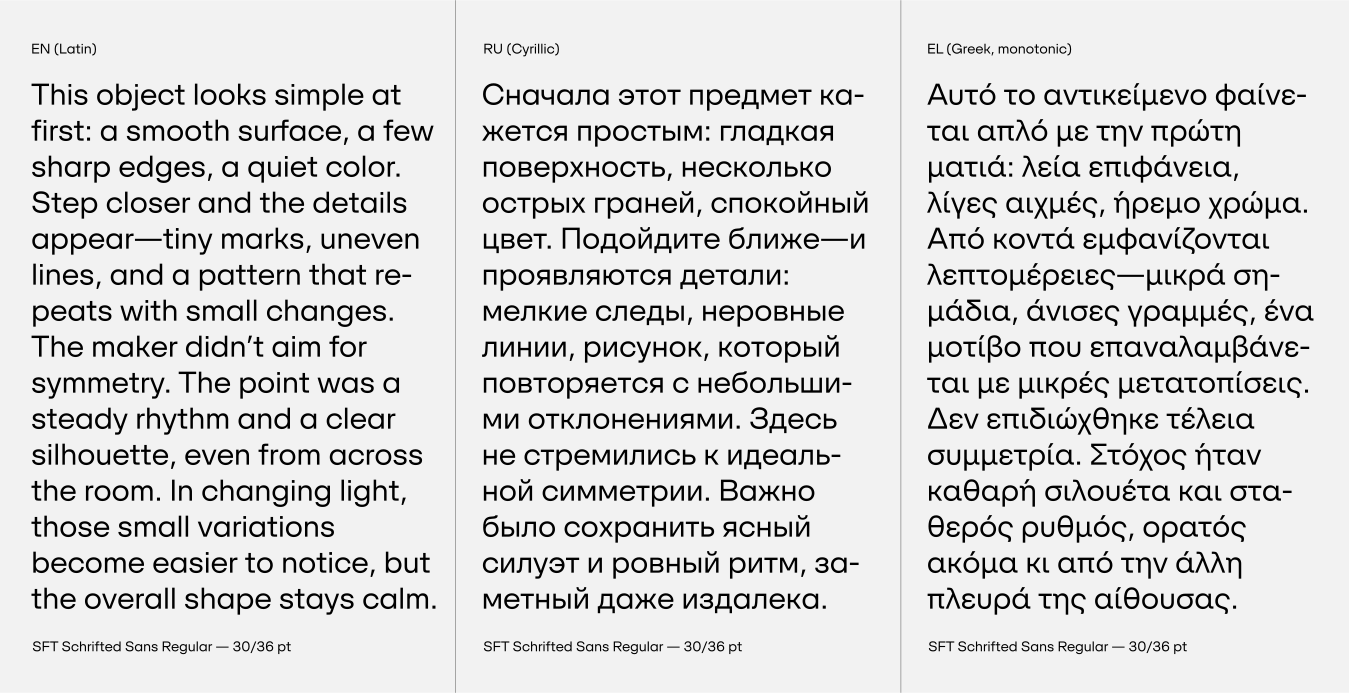
Parallel paragraphs in three scripts—compare overall texture and spacing rhythm.
What Had to Match
The Greek set follows the same criteria that already aligned Latin and Cyrillic inside the family:
Two details mattered most for SFT Schrifted Sans specifically. First, the squared, technological rounding. A clear reference point is Latin j/t. Second, the ink-trap logic at joins, which sets a particular “voice” for lowercase texture.
- Proportions
- Aperture openness/closure
- Joins and ink traps
- Curve treatment and terminals
Two details mattered most for SFT Schrifted Sans specifically. First, the squared, technological rounding. A clear reference point is Latin j/t. Second, the ink-trap logic at joins, which sets a particular “voice” for lowercase texture.
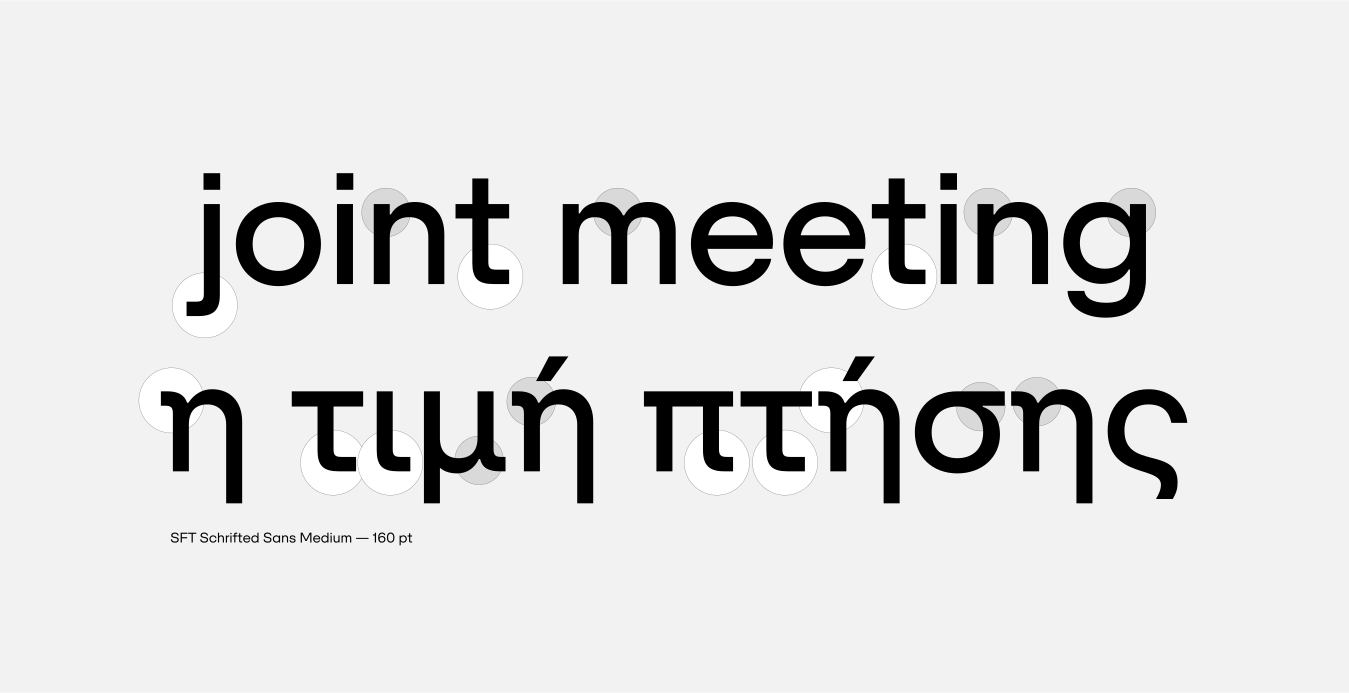
Terminals and joins across scripts—notice how the same detail logic appears inside different constructions.
Challenging Glyphs and Control Letters
Some glyphs take longer because there is no close analogy in Latin or Cyrillic. The most time-consuming forms were those with particularly distinctive Greek graphemes: zeta (ζ), xi (ξ), omega (ω), and the kai symbol (ϗ).
To keep decisions consistent, a set of “control letters” helps concentrate the family’s character and reveal drift quickly: lambda (λ), sigma final (ς), mu (μ), delta (δ), and nu (ν). These are useful precisely because they can be solved in multiple plausible ways, from minimalist to more humanist. A family’s stance shows up fast in those choices.
To keep decisions consistent, a set of “control letters” helps concentrate the family’s character and reveal drift quickly: lambda (λ), sigma final (ς), mu (μ), delta (δ), and nu (ν). These are useful precisely because they can be solved in multiple plausible ways, from minimalist to more humanist. A family’s stance shows up fast in those choices.
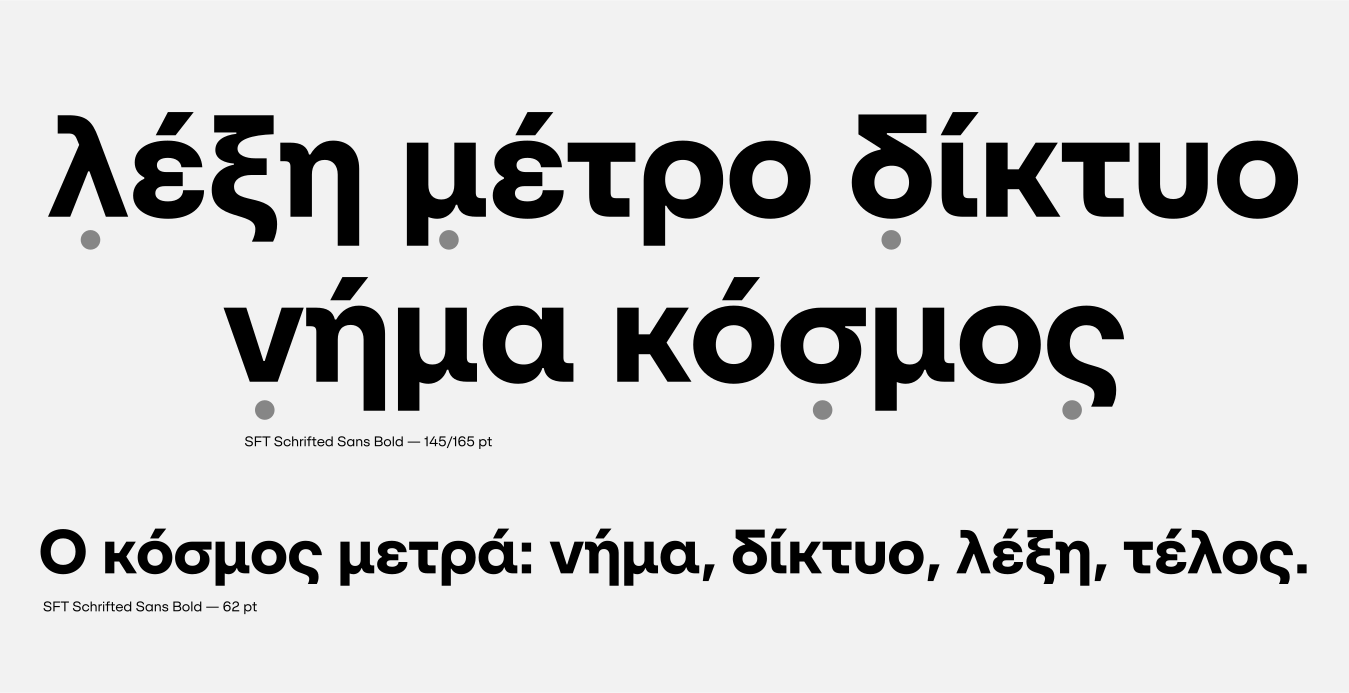
Control letters in context—shown in short words and a sentence to illustrate rhythm, spacing, and overall texture in Greek text.
Greek Form Choices
The main compromise was reducing complex constructions that would push the set toward a more explicitly humanist tradition. Letters such as gamma (γ), nu (ν), upsilon (υ), chi (χ), and psi (ψ) could have been drawn with more structural complexity, even within a static grotesque. Instead, decisions favored a calmer overall picture, with dynamic accents used sparingly.
A clear example is lambda (λ). It keeps an upper “tail” to preserve liveliness, but drops a corresponding lower detail to keep the balance between calmness and movement.
A clear example is lambda (λ). It keeps an upper “tail” to preserve liveliness, but drops a corresponding lower detail to keep the balance between calmness and movement.
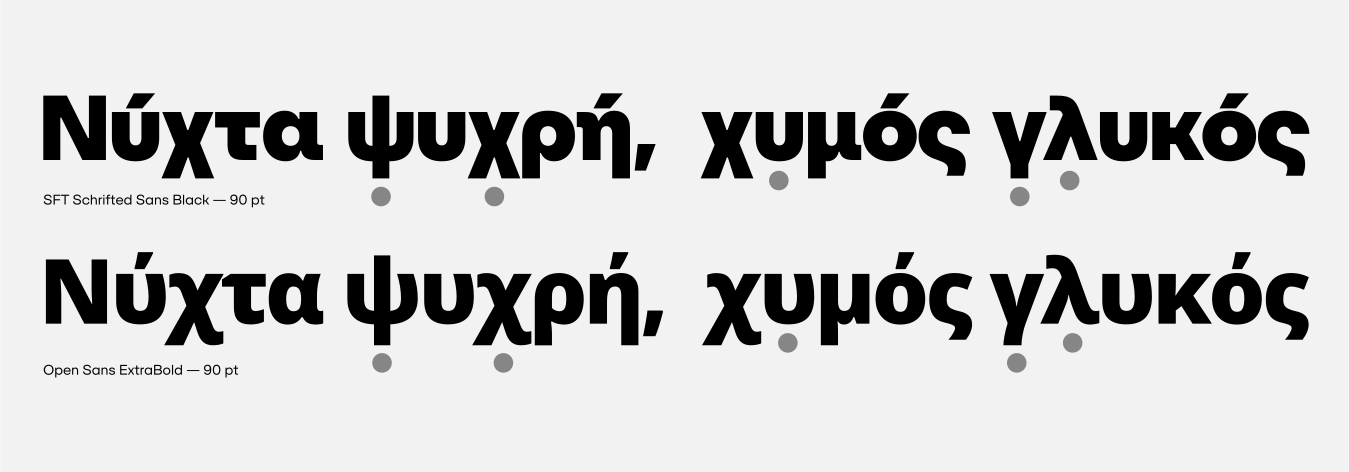
Same phrase set in SFT Schrifted Sans and Open Sans—compare construction and terminals in λ, γ, υ, χ, ψ, and how those details affect rhythm across the line.
Spacing Checks
For a non-native reader of Greek, spacing can be the hardest part to judge near the finish line. Without habitual exposure to the script’s text rhythm, it is more difficult to separate real spacing issues from unfamiliar patterns. As familiarity increases, fewer moments read as problems, and the remaining borderline cases can be balanced more precisely.
The working method for spacing checks was pragmatic: real texts in Greek and pangrams, used continuously, without relying on one canonical test string.
The working method for spacing checks was pragmatic: real texts in Greek and pangrams, used continuously, without relying on one canonical test string.
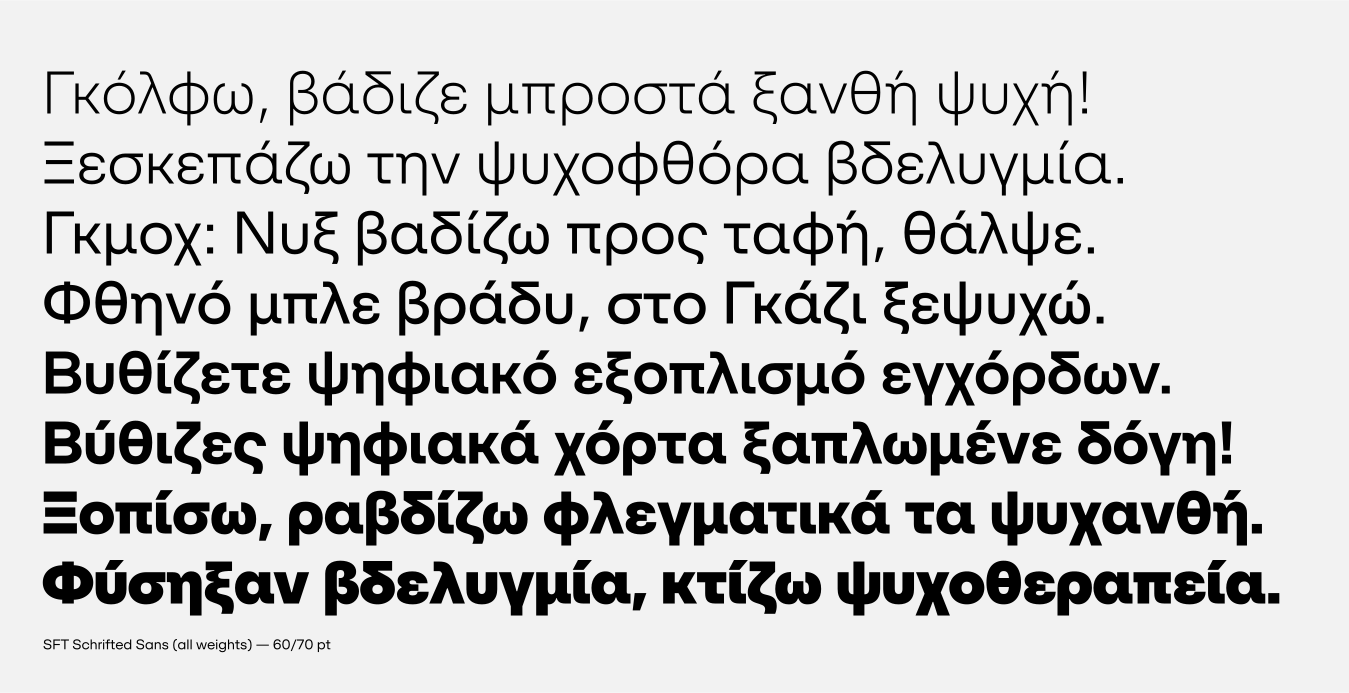
Greek pangrams set across all weights in upright and italic, used to check spacing rhythm and overall text color across the full family.
Consultation Insights
Consultation started early, while the overall direction was still being chosen. Early feedback confirmed some decisions, proposed alternatives for disputed moments, and then focused on fine proportional corrections and balance adjustments across elements.
The practical value of consultation is easiest to see in the checks behind it. Below is an excerpt from Greek consultant Kostas Bartsokas.
The practical value of consultation is easiest to see in the checks behind it. Below is an excerpt from Greek consultant Kostas Bartsokas.
“
When reviewing/designing a Greek extension of an existing Latin font, I am conscious of the following key areas: structure of the letters, terminals and joins, and how the Latin ideas can reflect to Greek, stress (if any), rhythm and fitting, and, of course, colour (especially in heavier styles). I want the letters to be Greek and not Latin-derived.
The way I check for consistency is by typesetting English (and other Latin-using languages) and Greek texts side by side, as well as English words within Greek texts, which happens more often than Greek words in an English text.
I would say [the key is] respecting the Greek structure over the Latin analogy. Designers sometimes “translate” Latin shapes into Greek rather than understanding the script’s internal construction. A careful Greek acknowledges that it is a distinct writing system with its own logic—not a stylistic variation of Latin. When I work on a sans, it is my aim to find how the character of the Latin sans (humanist, grotesque, geometric, experimental, etc.) translates to the Greek letters and how to match the core idea without plagiarising the Latin shapes.
The way I check for consistency is by typesetting English (and other Latin-using languages) and Greek texts side by side, as well as English words within Greek texts, which happens more often than Greek words in an English text.
I would say [the key is] respecting the Greek structure over the Latin analogy. Designers sometimes “translate” Latin shapes into Greek rather than understanding the script’s internal construction. A careful Greek acknowledges that it is a distinct writing system with its own logic—not a stylistic variation of Latin. When I work on a sans, it is my aim to find how the character of the Latin sans (humanist, grotesque, geometric, experimental, etc.) translates to the Greek letters and how to match the core idea without plagiarising the Latin shapes.
In this project, the most explicit “changed mind” moment was omega (ω). An initial, stricter minimalist approach was revised after consultation toward a direction that felt more logical within Greek itself, while still fitting the family’s tone.
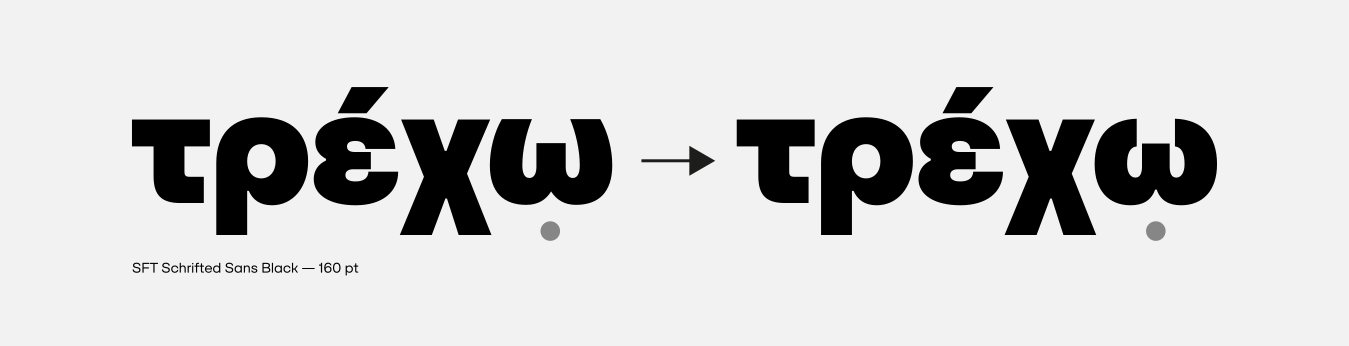
Omega in context—one word set in two versions (earlier vs revised).
Conclusion
Greek support in SFT Schrifted Sans is built as part of the family system: proportions, spacing, rhythm, joins, and terminals align with the existing Latin and Cyrillic. The set stays restrained overall, with small dynamic cues where Greek needs them, and it is validated in text through spacing work and specialist review. The trial is the quickest way to check mixed-script lines, small sizes, and heavier styles in your own context.
FAQ: Greek Support in SFT Schrifted Sans
- Does SFT Schrifted Sans support Greek, and in which styles? Yes: monotonic Greek across all weights, widths, and italics.
- Does it include polytonic Greek? No: monotonic Greek only.
- Which version added Greek support? v1.300 (February 2026 update).
- Why add Greek to a Latin/Cyrillic family? Latin and Cyrillic cover much of the Balkans; Greek completes regional script coverage and is also needed for EU localization, publishing, and technical notation.
- What matters most in mixed-script setting? Consistency in proportions, spacing rhythm, and text “color” across all three scripts.
- Was the script reviewed by a specialist? Greek consultant: Kostas Bartsokas.
- Where can the trial be downloaded? See the “Get Trial” button below.
What to Test in the Trial
A trial file is most useful when it’s tested in the contexts where Greek will actually appear. A quick checklist:
- Mixed-script lines: text in Greek with embedded Latin words (common in a Greek setting), and mixed-script paragraphs side by side.
- Small sizes: a paragraph at your target UI or editorial sizes—watch rhythm and spacing.
- Heavier styles: Bold/Black text and headings—check overall color and diacritic behavior.
- Control letters: words and lines that include lambda, sigma final, mu, delta, and nu.
Related Articles
Level up your typography!
Catch insightful articles on fonts, helpful tips, and deep dives into font usage across various markets.